

Blog 169 - Marine Musings - Automation and the Future of Gastronomy
- ranganathanblog
- Nov 30, 2025
- 3 min read

To the Marine Engineer who has had his baptism by fire in the 1960s and 1970s, he has seen the transformation of most of his routine work being taken over by hydraulics or pneumatics or electronics, under the grand heading of "Automation".
On the one hand, Automation is the angel which has eased his workload, for example the monitoring of a pressure or temperature, which he now does from the confines of a sound proofed and air conditioned Engine Control Room, rather than a near run to different corners of a hot and humid Engine Room to manually sight a pressure gauge or a thermometer.
On the other hand, Automation has had far reaching effects on having increased the strain and pressure of the workload on every individual Engine Room staff with the doing away of many ranks, thereby reducing the staffing of an Engine Room from a comfortable 18 to the present 8 - or even less - on the basis of certified "Unmanned Machinery Spaces" and "Minimum Manning Certificates".
Here, in this Blog, I intend to show Automation in a different form, in a different industry - the Food Industry. As hotel chains keep stretching and getting longer and longer, the practicality of a centralised kitchen becomes apparent, even necessary, so as not to duplicate the same equipment X number of times in each branch. There is also the challenge of maintaining the same quality, the same taste and texture of each dish - to the extent possible - even in the far flung branches of the hotel chain.
A case study was needed as to the number of dishes, the quantity, the quality, the sustenance of each dish etc . It soon became obvious that just increasing the manual labour force would not be a productive step, in maintaining not only the volume involved but also the quality to be adhered to.
"Automation" was needed.
At this stage I am reminded of the 'Dhabas' between Delhi and Chandigarh that locate themselves practically every kilometre of the highway. Truckers stop. Tourists stop. Giant buses stop at one or other of these Dhabas..
They were one of the first to automate 'Lassi' making, due to the sheer demand for the drink and the prodigious quantity that was required to slake the thirst of thousands of travellers. Ordinary 'mixies' would not do. They had to innovate. The idea to use automatic washing machines, the cycles wired to specifications, was nothing short of genius.
Basically, you keep the 'spin' cycle and the 'drain' cycle, add the ingredients required to make Lassi and you have 12 to 14 litres of Lassi ready for consumption every few minutes.
Of course, they now have dedicated Lassi making machines.
Below I give a few images of the workflow process involved in a few dishes, presently confined to South Indian dishes.
"IDLI" MAKING


The 'Idli' batter entering the steamer in trays
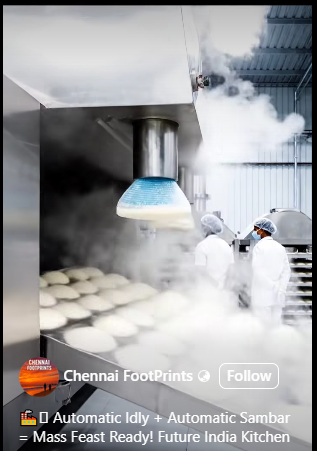

The steamed 'Idli' exiting the steamer in stacks


There are any number of ancillary automated units - cutting vegetables for the sambhar, adding the salt and spices etc. Usually, the supply of batter, vegetables, spices is sub contracted to make the whole. Manpower is required at every stage for quality control and also for regularly washing the plant down to maintain hygiene.
Vegetable 'Upma' Making

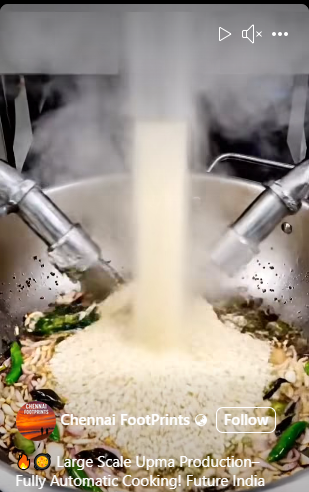


The Making of 'Sambhar'


Vegetable Biryani automated


The mixing of cooked rice and veggies

AR


Comments